
Las Vegas has long been a city that does things differently. Where else are you going to find gaming in grocery stores? Or movie theaters and bowling alleys within the confines of a large resort? And in what other city can you get anything you want whenever you want, 24 hours a day?
It’s in that spirit that Las Vegas Magazine decided to launch its inaugural Hall of Fame—the normal rules do not apply. Unlike the Rock and Roll Hall of Fame (where you’re only eligible 25 years after the release of your first record) or the National Football League Hall of Fame (where you must be retired for at least five seasons to be eligible) Las Vegas Magazine’s honorees are eligible once they set down roots in town—it could be three years, it could be 50. If they made a significant impact on the history and culture of this town, they’re up for consideration. There’s only one other key criteria—our readers have to be able to enjoy them here and now.
That said, any discussion of a Hall of Fame would not be complete without a nod to the legends that came before and paved the way for the current crop of honorees. There are far too many to mention here, but the Rat Pack, Liberace, Celine Dion, Elvis Presley, Les Folies Bergere, Siegfried & Roy, Elton John, Jerry Lewis and Louis Prima have all cemented their place in that pantheon.
One more twist: This class of honorees will have a hand in choosing the 2021 Hall of Fame class. As Las Vegas continues to evolve, we personally can’t wait to see who makes this list next year.


Photo by: Christopher DeVargas
Absinthe
Bawdy and boisterous, daring and delightful, Absinthe at Caesars Palace popped up its Spiegeltent in 2011 for what was supposed to be a limited-time run. It turned into a successful eight years of celebrating a type of entertainment that has since been mirrored at other properties across the city, but none come close to the original.
Absinthe’s salty and successful production—made up of a series of vignettes featuring a cornucopia of burlesque, vaudeville, variety and circus-like acts mixed with very R-rated comedy—is hosted by the over-the-top and profane Gazillionaire, who delights insulting as many audience members as he can before introducing the various acts. His assistant, Wanda Widdles, is quick to back up her boss with a few naughty zingers of her own (not to mention some suggestive pantomime).
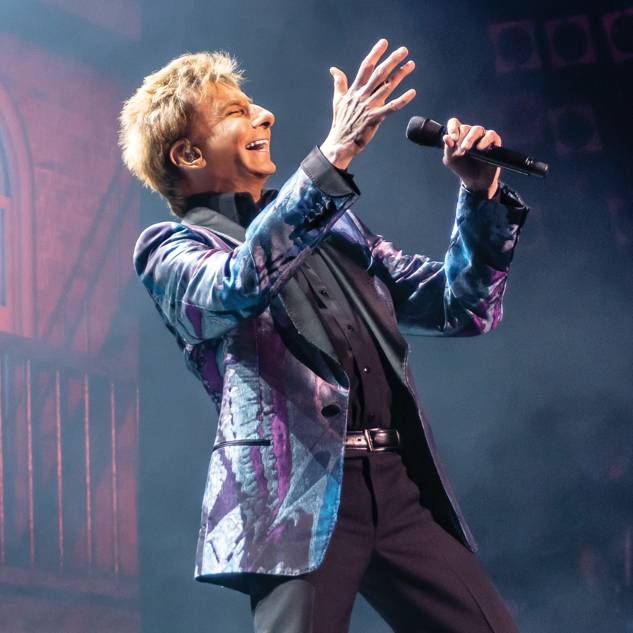
Photo by: Dan Lornitis
Barry Manilow
Barry Manilow, who holds a special place in the hearts of his fans and Vegas visitors, is an important presence here in Las Vegas. His residency continues to evolve— after all, at times, it’s difficult to pinpoint what works in this town. But Manilow’s superior showmanship acts as a guide to all performers seeking a successful residency in Vegas.
In a recent interview with Las Vegas Magazine’s Brock Radke, Manilow said that within the last six years, he’s noticed a change in his audiences. “I would try to throw in an album cut and they’d be okay with it,” he explained, “but then I’d do ‘Can’t Smile Without You’ and the roof would cave in.” Audiences were telling Manilow exactly what they wanted—the hits. Moreover, they simply want to be in his presence, singing along to the songs that defined their lives.

Photo by: Christopher DeVargas
Carrot Top
Believe it: It’s been 15 years since Scott Thompson, aka Carrot Top, secured a residency at Luxor in 2005, becoming the longest-running comedy act MGM Resorts International has ever signed.
One could surmise that Thompson’s success is due to brand recognition (because that curly mop of ginger hair is recognizable anywhere), or, simply, because he’s funny. But that’s all low-hanging fruit. Carrot Top has been successful in Vegas because he’s essentially taken a page from Vegas’ own playbook: In order to stay relevant, one must adapt. So, much like the town that constantly adjusts when tastes in style and entertainment change, Thompson, like any great comic, takes notes on pop culture and gets to work in his garage, consistently pumping out timely material in the form of new props—it’s prop culture, if you will.

Photo by: courtesy of Cirque Du Soleil
Cirque du Soleil
Even before Cirque du Soleil launched its first permanent production Mystère at Treasure Island in 1993 and changed the face of Las Vegas entertainment forever, the Montreal-based creative company founded by former street performers Guy LaLiberté and Gilles Ste-Croix made an impact on the Strip with the modern circus “Nouvelle Expérience.” That show had been touring North America for two years before it touched down at the Mirage and offered a wild contrast to the traditional production show dominating casino theaters at the time.
Flash forward nearly three decades and Cirque du Soleil’s stable of seven Strip productions define the current concept of a Las Vegas production show. The company’s inspired innovation and otherworldly approach to creating theater may have become the norm, but Cirque has never stopped taking risks and leading the way when it comes to experimental entertainment.

Photo by: Erik Kabik
The Colosseum at Caesars Palace
Dynamic, unrivaled venues are the X factor that makes today’s Las Vegas the true entertainment capital of the world. Big or small, luxurious or modern minimal, music-inclined or multi-purpose, this city’s got everything. But there may not be another room that has impacted Las Vegas—or live entertainment in general—the way the Colosseum has.
Believe it or not, it was a risky project from its inception: a posh 4,300-seat theater built for one show from one singular superstar, Celine Dion, in 2003. It’s unimaginable in today’s entertainment industry environment that a venue of this scale would be constructed for one artist, on the Strip or anywhere else. But Celine’s show and the Colosseum became legendary success stories, paving the way for the modern residency headliner production.

Photo by: Anthony Liwag
David Copperfield
David Copperfield is more than an icon; his name is simply synonymous with magic. And Las Vegas could never have grown into the magic capital of the world without his presence. Even on the Strip’s current entertainment landscape where illusionists with varying styles and reputations are thriving, his intimate and astounding show at MGM Grand stands as the standard bearer while the artist himself continues to inspire the next generation of talent.
The secret to his longevity in Las Vegas sounds simple but seems impossible: Copperfield always astounds. There are those in his audience who recall when Copperfield survived a plunge over Niagara Falls, walked through the Great Wall of China and made the Statue of Liberty disappear during classic TV specials. Some of them are now bringing their kids and grandkids to see the master in person, and he doesn’t disappoint, even compared to the scale of those impossible feats.

Photo by: Christopher DeVargas
Fountains of Bellagio
Bellagio is one of the most famous hotels in the world, one of the first resorts that springs to mind when anyone is thinking or talking about Las Vegas. But would that name contain the spirit and excitement if not for the fantastic fountain show that celebrates that spirit every day and night from the man-made lake on Las Vegas Boulevard? We think not.
Since their stunning debut more than 21 years ago, the Fountains of Bellagio have entertained countless visitors on the way to becoming an emblem of an era of Las Vegas, much like the Rat Pack in the 1960s and Elvis after them.

Photo by: courtesy of Tao
TAO Las Vegas
A major shift in nightlife happened in 2005 when TAO Nightclub and Bistro opened its doors at The Venetian. The all-encompassing night of dinner and dancing inside a multistory, 60,000-square-foot ornate and luxurious “Asian City” was an instant hit with the celebrity and jet-set crowds.
Inside the restaurant—which continues to be the highest-grossing restaurant in the U.S.—guests begin their evening with specialty cocktails in the lounge followed by dining on elevated Pan-Asian cuisine under a towering 20-foot Buddha.

Photo by: Christopher DeVargas
Vegas Golden Knights
If there is such a thing as the hottest show in Las Vegas, it must be something that’s selling a record number of tickets and generating nonstop buzz. It must be endlessly exciting and it’s likely accomplishing that goal by creating a different experience every night.
No one predicted the immediate success of the Vegas Golden Knights, Las Vegas’ first major league professional sports team. The Knights recorded arguably the greatest season by an expansion team in any sport during its inaugural 2017-’18 campaign by claiming the NHL’s Western Conference and making it all the way to the Stanley Cup Finals. The Knights’ electric, speedy style of play and the over-the-top entertainment experience created at “The Fortress” for home games have created a true sensation. Over the first two seasons, average attendance at T-Mobile Arena was 18,180; the listed capacity for hockey games at T-Mobile Arena is 17,500.

Photo by: Erik Kabik
Wayne Newton
When you talk about the formation of Las Vegas entertainment, there are a few people who come to mind: Frank Sinatra, Liberace, Elvis Presley and, of course, Mr. Entertainment himself, Wayne Newton.
Virginia-born Newton had a musical bent from the very start, learning multiple instruments when he was just a youngster. In 1958, when he was just a teenager, he and his older brother started playing Vegas, and that opened up a world of opportunity, from appearances on The Jackie Gleason Show to his deal with Capitol Records, which resulted in his signature 1963 song, “Danke Schoen.” That was far from all of his hits through the years: “Daddy Don’t You Walk So Fast,” “Red Roses for a Blue Lady” and “I’ll Be With You in Apple Blossom Time” were favorites through the years.

Photo by: Vanessa Stump
Wolfgang Puck
The legendary culinarian Wolfgang Puck has received quite a bit of credit for jump-starting a Las Vegas restaurant renaissance by opening Spago in the Forum Shops at Caesars Palace in 1992. While other celebrity chefs soon followed in his footsteps and casino food and beverage executives put the work in to create the wondrous dining paradise you currently see (and taste) before you, it’s important to understand Puck’s pioneering move to the Strip.
The first modern megaresort, The Mirage, had only been open for five years, and Bellagio, the resort where Spago relocated last year and the property that truly created the blueprint for elite restaurant rosters, was still six years away. And the daring Austrian did more than seize an opportunity, he absolutely committed to Las Vegas and the local community and industry, setting down firm roots that still distinguish his Las Vegas company from any other operator today.


